
Yam on the island’s hill after the sun goes down // Yam on the island’s hill before a thousand years (2025)
Wall murals, Fort Canning MRT Station and Dhoby Ghaut MRT Station (Singapore)
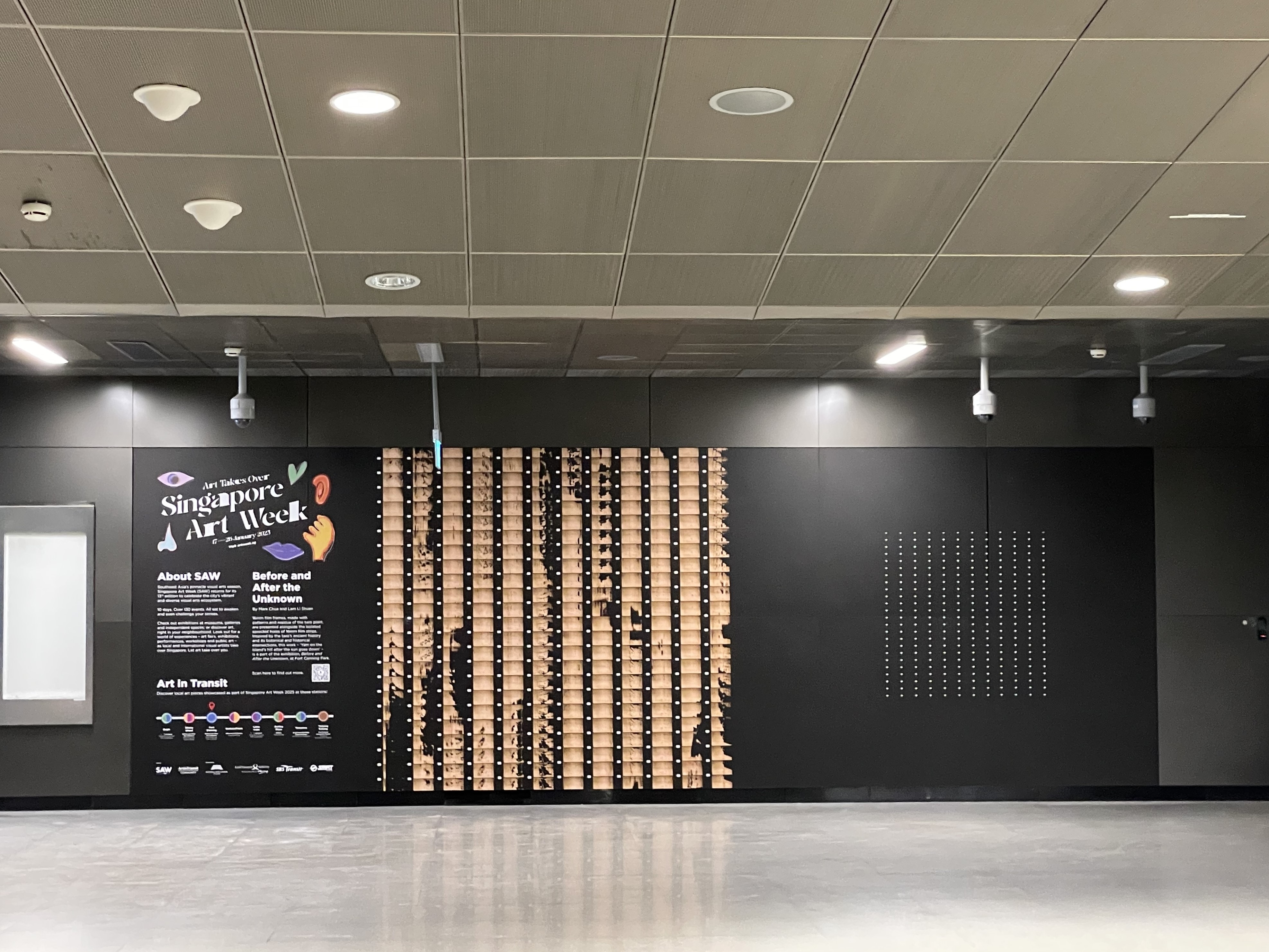
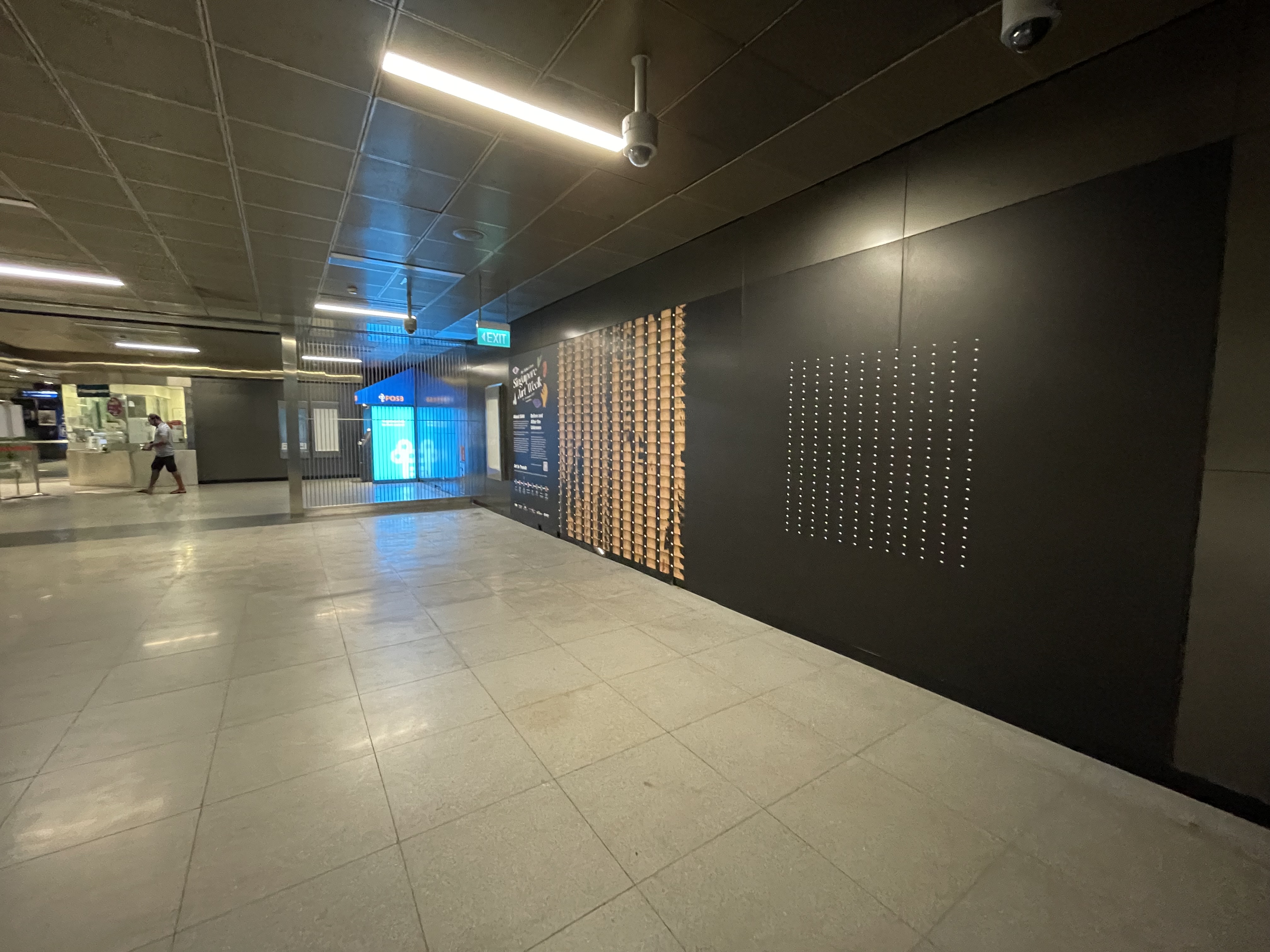
Yam on the island’s hill after the sun goes down (Fort Canning MRT Station)
16mm film frames, made with patterns and residue of the taro plant, are presented alongside the isolated sprocket holes of 16mm film strips, representing 12 seconds of 24 frames each. Inspired by the taro and its ancient history, the work thinks on the connection between analog cinema and plant life, in the resonances between light and the passage of time.
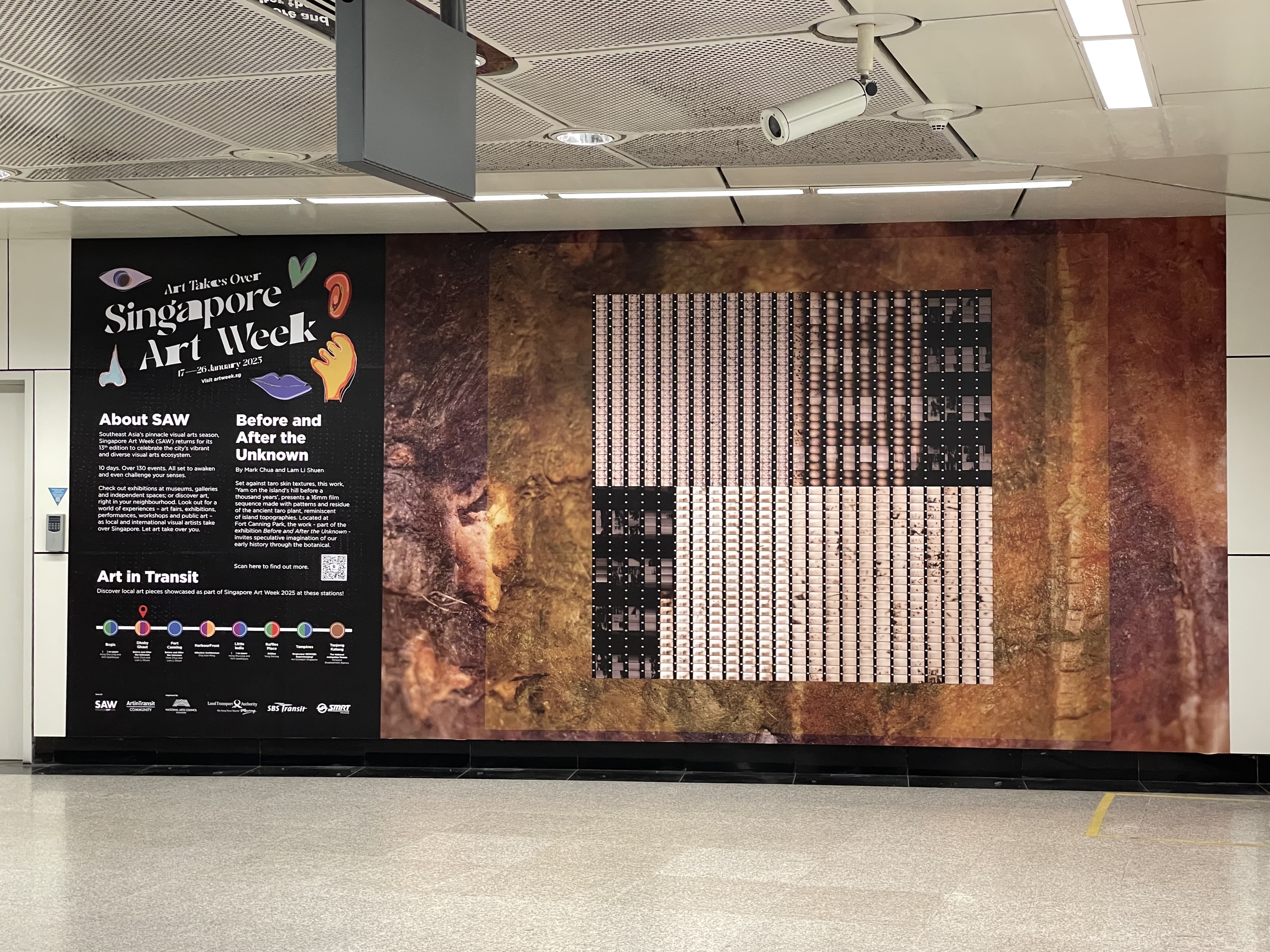
Yam on the island’s hill before a thousand years (Dhoby Ghaut MRT Station)
Set against the textures of taro skin, this work presents a 16mm film sequence made with patterns and residue of the ancient taro plant – reminiscent of topographical images of islands and riverways. The sequence consists of 48 seconds of 24 frames each. Navigating the relationship of the moving image to histories and materialities, the work invites a speculative imagination of the unknown fragments of our early history through the botanical.
Yam on the island’s hill after the sun goes down (2025) // Yam on the island’s hill before a thousand years (2025)
Wall murals, Dhoby Ghaut MRT Station and Fort Canning MRT Station (Singapore)
Yam on the island’s hill after the sun goes down (Fort Canning MRT Station)
16mm film frames, made with patterns and residue of the taro plant, are presented alongside the isolated sprocket holes of 16mm film strips, representing 12 seconds of 24 frames each. Inspired by the taro and its ancient history, the work thinks on the connection between analog cinema and plant life, in the resonances between light and the passage of time.
Yam on the island’s hill before a thousand years (Dhoby Ghaut MRT Station)
Set against the textures of taro skin, this work presents a 16mm film sequence made with patterns and residue of the ancient taro plant – reminiscent of topographical images of islands and riverways. The sequence consists of 48 seconds of 24 frames each. Navigating the relationship of the moving image to histories and materialities, the work invites a speculative imagination of the unknown fragments of our early history through the botanical.
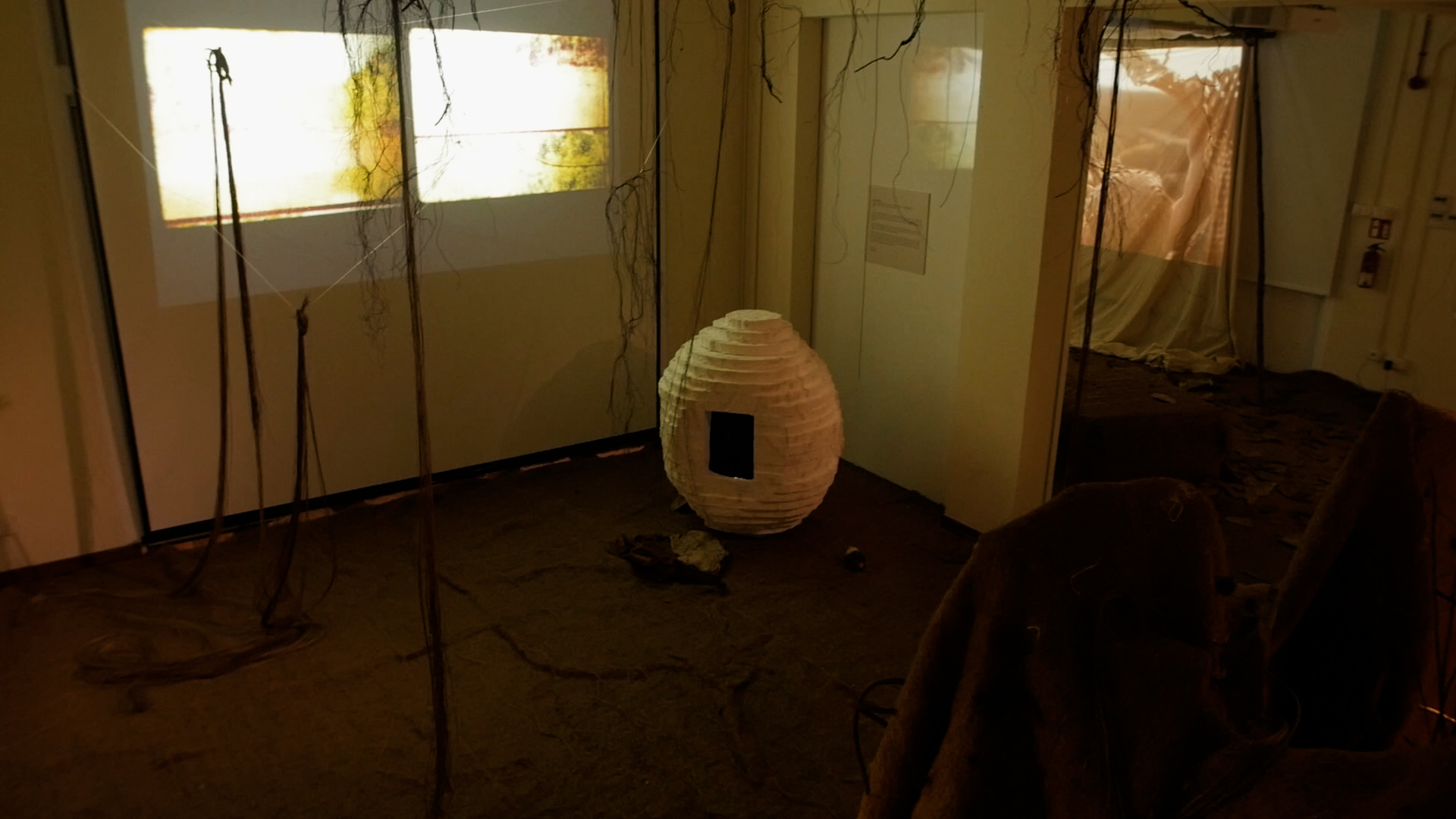
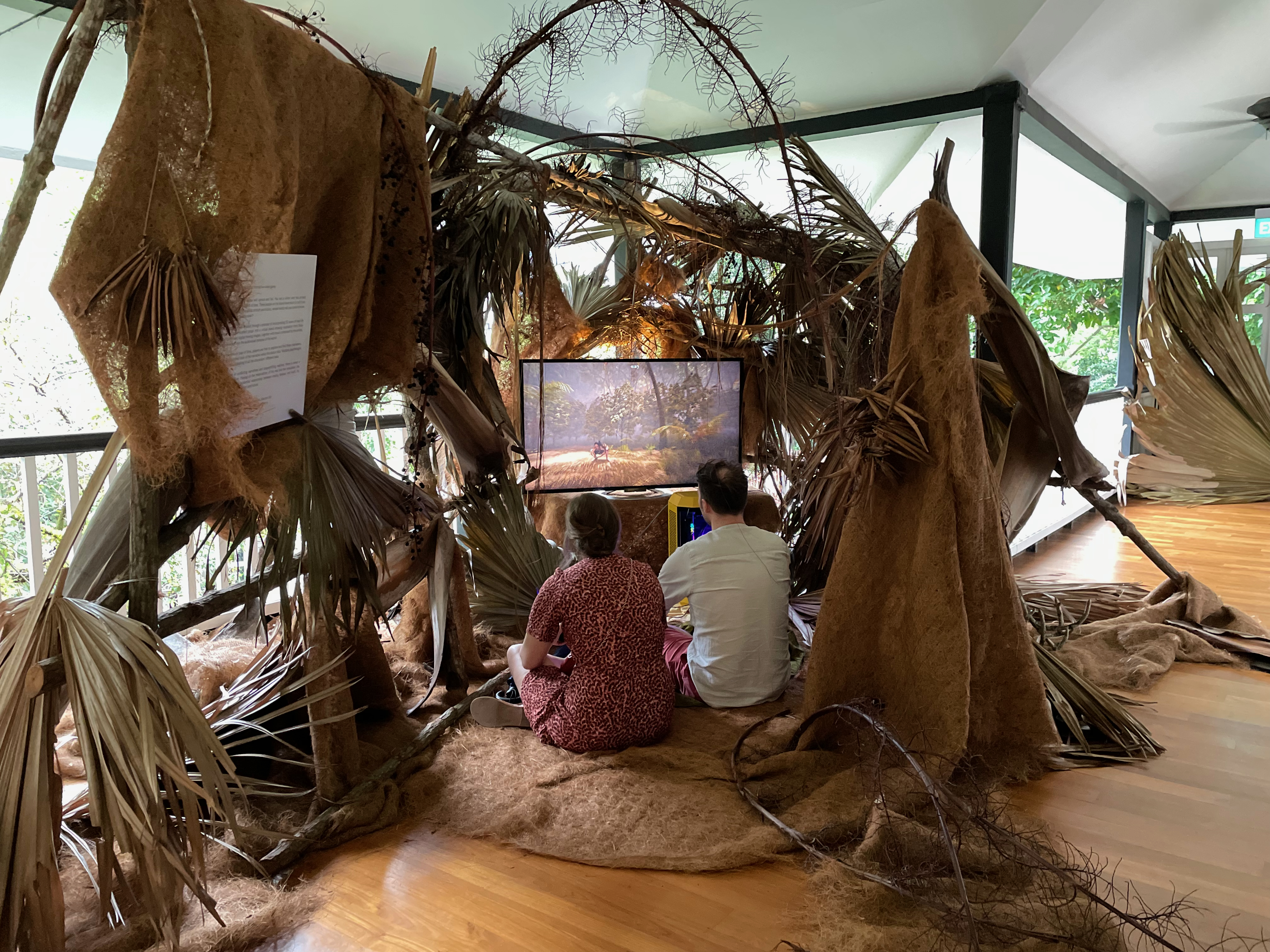
Before and After the Unknown (2025)
Multimedia exhibition, Fort Canning Park – Lewin Terrace (Singapore)
Multi-channel video (digital and 16mm), sculpture, interactive video game
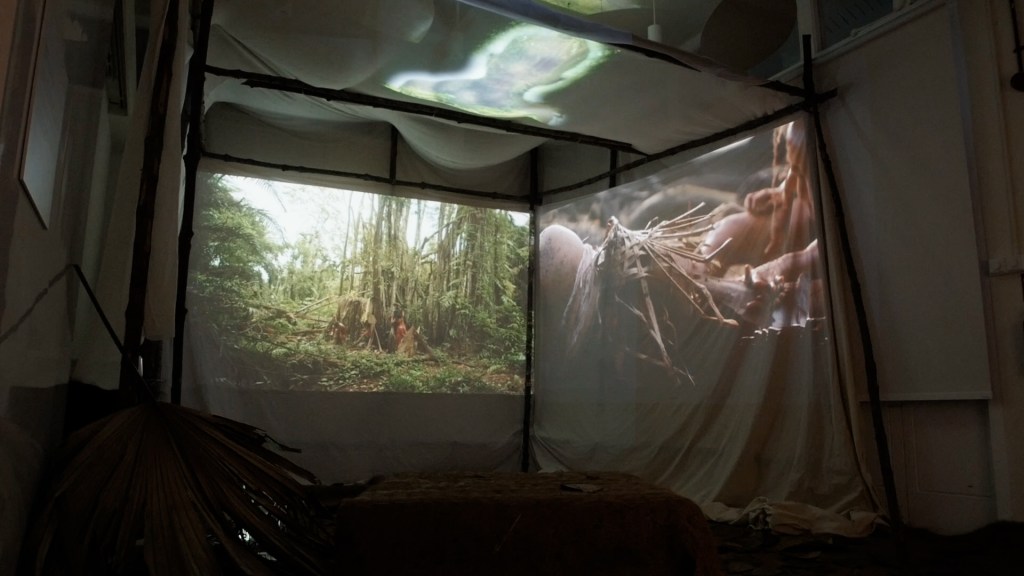
Before and After the Unknown is a multimedia exhibition by Mark Chua and Lam Li Shuen, set within a speculative fiction universe of Temasek island in the 11th century.
Our existence is an island in time, always before and after the unknown. What selves might we find, in the performance of a fictive past?
Past, present and future collide in a fantasy of materialities and histories. Between expanded cinema, a video game and sculptural fictions, the exhibition presents pieces of a deconstructed myth. It draws from the lost fragments of the land’s early history – their traces in both the bodily and the botanical – and the unknown possibilities of our future trajectories.
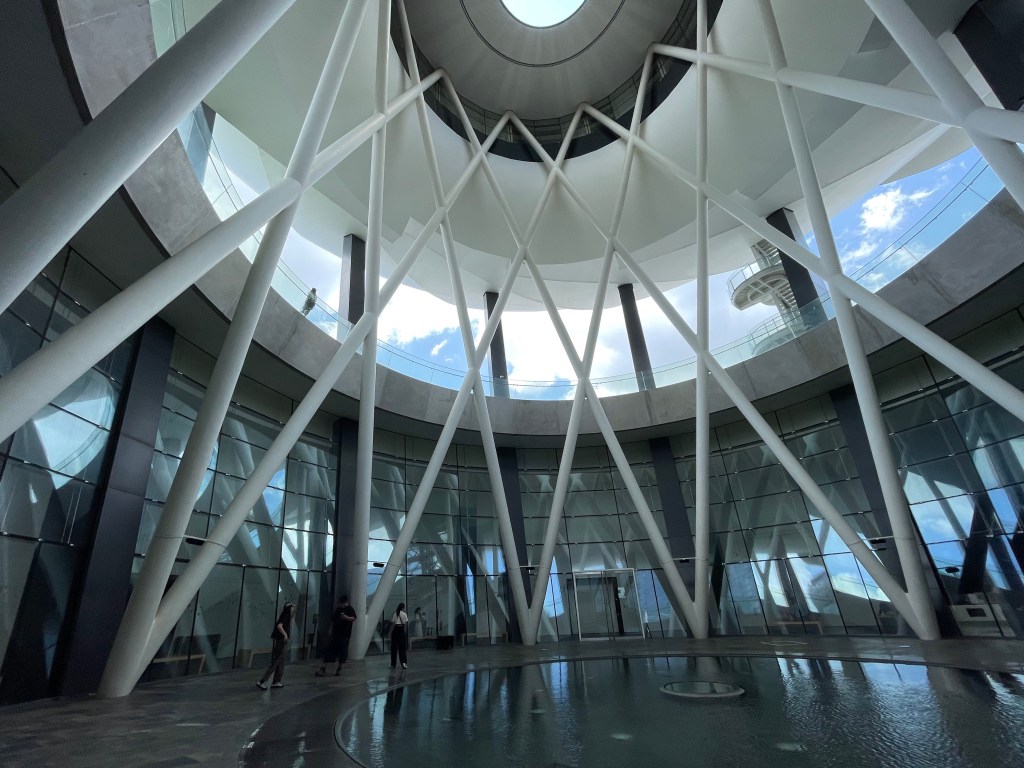
A Lotus Turns To Light (2024)
Sound installation, ArtScience Museum (Singapore)
10-channel sound
A lotus flower blooms in the morning and closes by evening. The next day, it begins again.
A Lotus Turns To Light is a time-based 10-channel sound and light installation considering the cycles of light within the Oculus and its structure. It is inspired by the cycles of lotus flowers, light and time. We wanted to hear the sound of their visual form, to weave a kind of auditory speculative fiction.
Three different movements were composed for different times of the day. Within each of the movements, the same three motifs repeat, interpreted through the time of day and the changing form of light.
Being both filmmakers and musicians, we devised the motifs in a light-sound process that started with capturing three film sequences of the lotus, light and the Oculus structure. The sequences were made into physical film loops that were played through a 16mm film projector, where sounds would be generated from the images through the optical sound system. The sound of each film sequence was transcribed as musical notation and used as the basis of each motif.
The unique circular structure of the Oculus was thematically and spatially profound for us in this piece. We wanted to create within it, gentle, incidental, textural compositions, that incorporate spatial movement reflecting cycles and circularity. Instrumentation like woodwinds, tape loops, prepared guitar, vocals and synthesizers, were used in a balance of the physical and the ethereal.
With the piece, we wanted to draw upon the materiality of the lotus in its various forms, to create an organic sonic environment, where tones and textures drift through the Oculus, inviting a flow of memory, feeling and simply being.
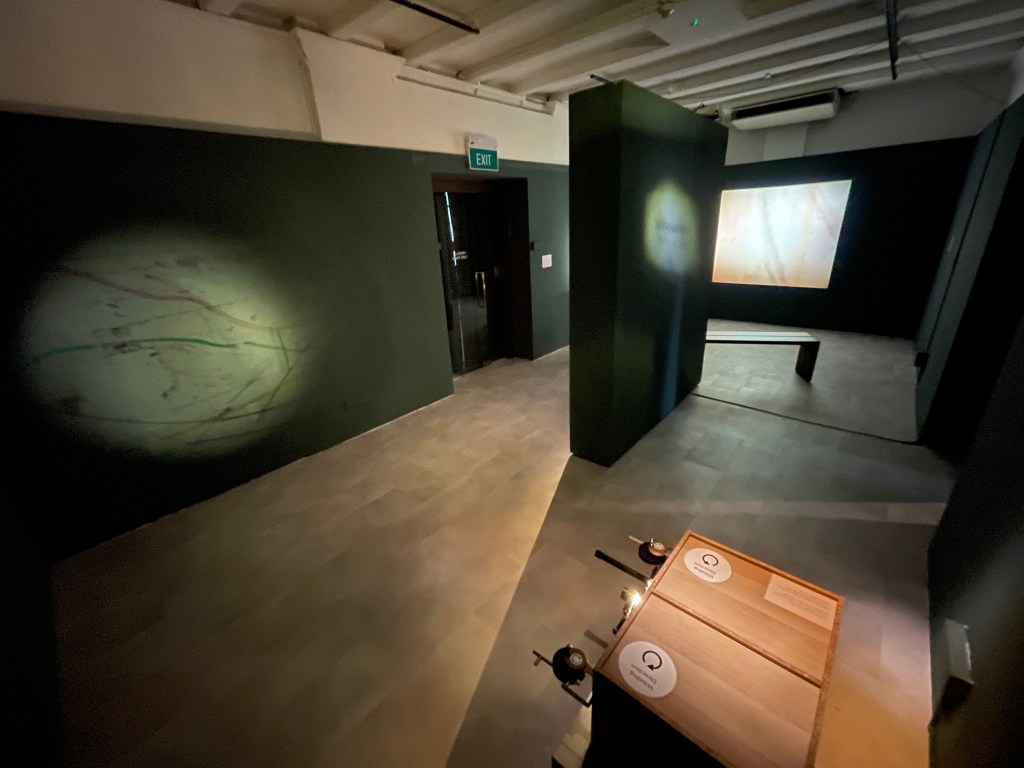
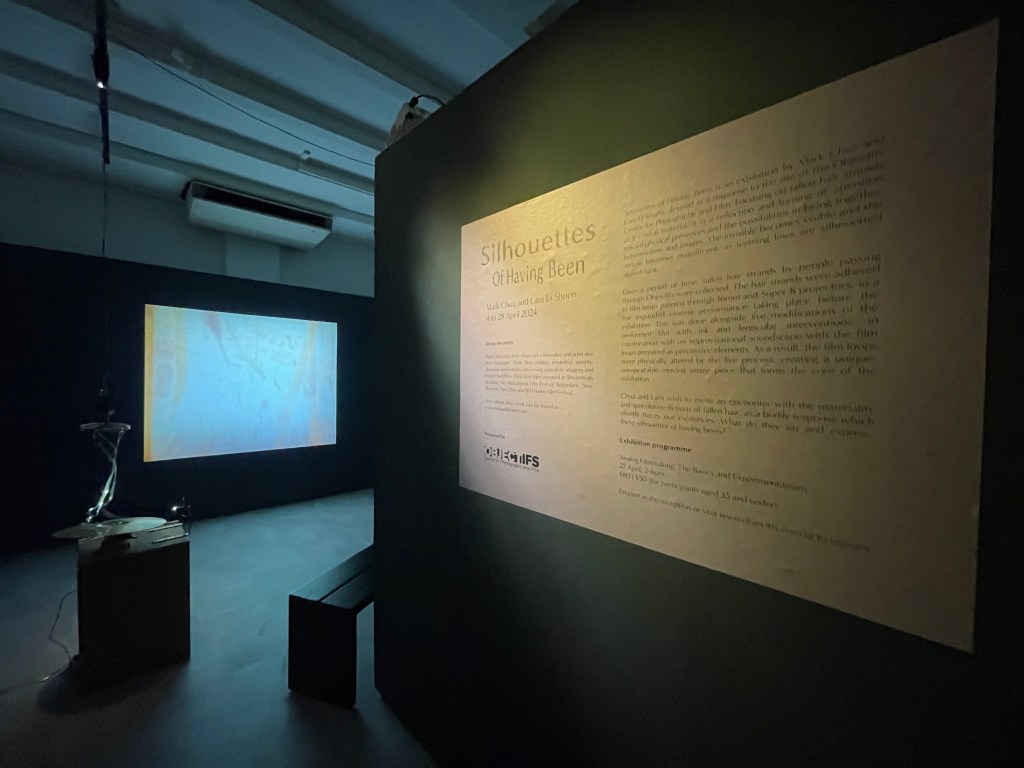
Silhouettes of Having Been (2024)
Moving Image Exhibition, Objectifs Centre for Photography and Film (Singapore)
Single-channel Silent Video (16mm and Super 8 projections), Kinetic Sound Mobile, Hand-Built Projection Device
Silhouettes of Having Been is an exhibition by Mark Chua and Lam Li Shuen, devised as a response to the site of Objectifs Centre for Photography and Film. Focusing on fallen hair strands as a central material, it is a reflection and turning of attention toward physical presences and the possibilities in being together between time and images. The invisible becomes visible and the minute becomes magnificent as teeming lines are silhouetted against light.
Over a period of time, fallen hair strands by people passing through Objectifs were collected. The hair strands were adhered to film loops running through 16mm and Super 8 projectors, in a live expanded cinema performance taking place before the exhibition. This was done alongside live modifications of the performed film with ink and lenticular interventions, in combination with an improvisational soundscape with the film loops prepared as percussive elements. As a result, the film loops were physically altered by the live process, creating a unique, unrepeatable moving image piece that forms the core of the exhibition.
In the exhibition, Chua and Lam wish to invite an encounter with the materiality and speculative fictions of fallen hair as a bodily response which silently traces our existences. What do they say and express, these silhouettes of having been?
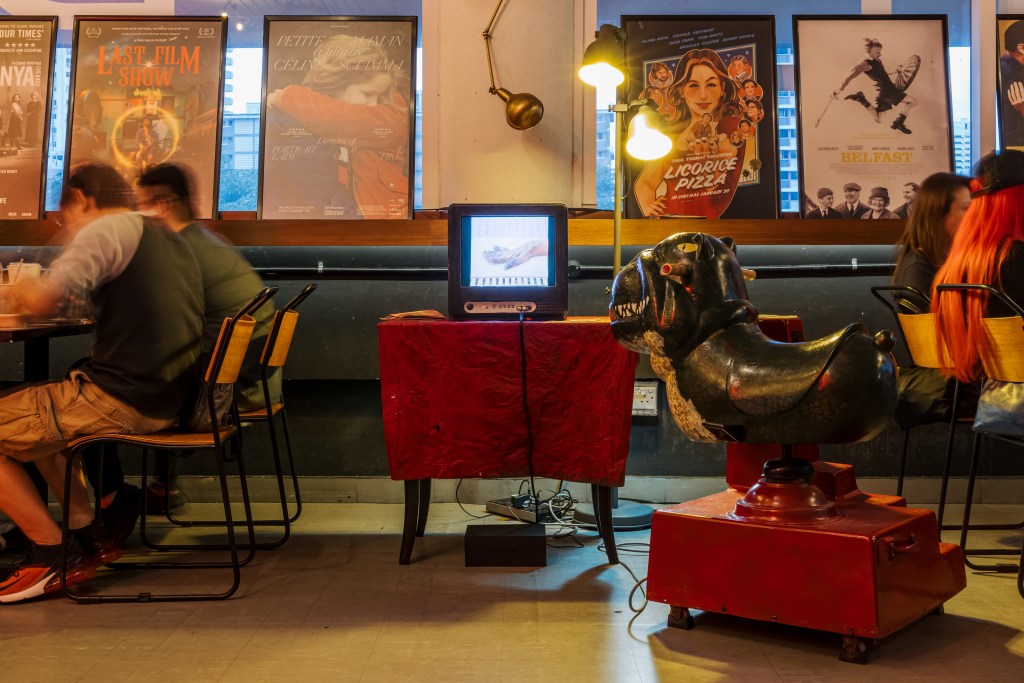
This Is My Brain On Demand (2022)
Moving Image Installation, The Projector (Singapore)
Single-channel Silent Video (Digitized 16mm Film), TV Monitor and Coin-Operated Ride Machine
This Is My Brain On Demand is an expression of, a thinking alongside and a conversation with the spirit of the Singaporean Ideal.
It is centered around a film piece shot on 16mm celluloid film, depicting a scene of crocodilian men basking in a swimming pool. The film sees one of these men being special compared to the others, in that he does not have the same crocodilian features they do but just a right hand with crocodile fingers. The initial appearance of calm in the swimming pool gives way to a strain and tension in relations between them. Their subjective interpretations of sacrifice and endurance against the other, brings to the fore a violence of difference and otherness.
What is the feeling of a Singaporean Ideal? How might this feeling look?
The film’s reptilian depiction takes the native estuarine crocodile as its inspiration and intends through this lens, to suggest and play on a reading of a Singaporean Ideal as a participation in a state of relations premised primarily on utility and value. And that within this participation, personal and collective drives are motivated by difference and otherness in sincere cold-bloodedness.
The film is displayed on a CRT (cathode-ray tube) TV, painted and modified as a crocodilian TV. On the monitor screen, a gloss coating was used to create a dripping visual effect, to evoke salivation, sweating, tearing; thinking on drives, negotiations, image and representation. Accompanying this display is a crocodile coin-operated ride that sits facing the screen, suggesting itself an anti-spectacle, a reflection on the moving image and the function of spectacle in its mediations.
EXHIBITIONS
– “It’s My Party and I’ll Cry If I Want To, You Would Cry Too If It Happened To You” presented as part of Singapore Art Week, The Projector, 2022 (Singapore)
– Singapore Pavilion at World Expo Dubai, 2022 (UAE)
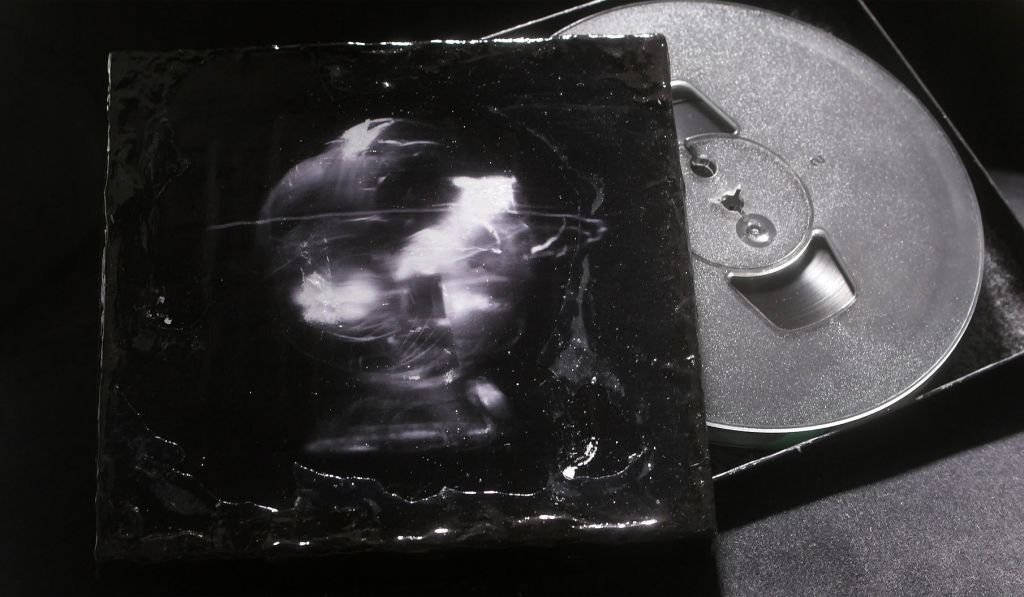
Never Seen The Roof (2021)
Sound Installation, Yeo Workshop (Singapore)
Audio recordings mastered to reel-to-reel tape
Never Seen The Roof is a concept album on love as a disruptive possibility, created and presented as a soundtrack to the group exhibition ‘only losers left alive (love songs for the end of the world)’ at Yeo Workshop, curated by Louis Ho. The album was mastered to reel-to-reel tape, and released on cassette and 7-inch reel.
The tracks of the release were created through an exploratory narrative approach, oriented around a fictive Jujon Street, the reverberation and decay of these times we live in. Visions of the odd inhabitants who graze slowly among its decaying environs. The tracks sound the moods of scenarios of reckless abandon, creaking hankerings, and the acceptance and rejection of what is to come – as multiple propositions on mad, exhilarating, tragic, desperate, sweet love.
Creating the work, analog equipment and put-together modifications and instrumentation were incorporated. Including different recording mediums on multiple tape decks as well as modified instruments, thinking composition and recording between the traditional and experimental. To tease out elements of sonic chance in noise, tone and artifacts, allowing for fluctuations based on variables of time, history and place. Especially with most of our soundscape in the media of our public and private life now saturated with a manufactured pristineness.
With the release being a soundtrack to the happening of the exhibition, we hope to play in such ways, toward musical and sonic setting and expectation. To propose a small gesture of thoughtfulness in the sound of relations, where chance can hold the possibility of love. Perhaps by the melding of the visual and tactile with the sonic space of the show, teasing the question – is this, being here, what love as some disruptive possibility could or does feel like?
EXHIBITIONS
– “only losers left alive (love songs for the end of the world)” presented at Yeo Workshop, 2021 (Singapore)
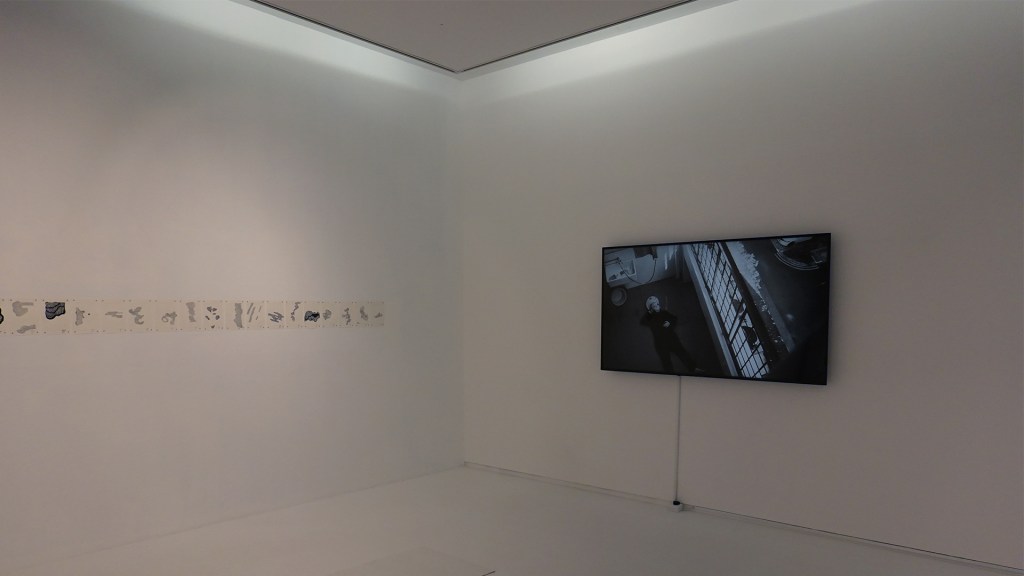
The Cup (2020)
Moving image installation, Sullivan+Strumpf Gallery (Singapore)
Single-channel video with sound
The Cup is a surreal tableau of a man with a brewing machine for a head. Discontent with the bland taste of his own brew, he attempts to do what he can to improve its flavour. The work is a meditation on being in the world, upon the flattening out of life as we know and image it during the pandemic, and was first presented as a video installation as part of a group exhibition ‘flat’ at Sullivan+Strumpf Gallery (Singapore).
The pandemic and its effects, in some sense, have profoundly altered our envisioning of being in the world. Perhaps due to the large intersection of our collective lived experience in this period around the globe. While the restrictions in daily life protect oneself as well as the general public from the spread of the pandemic, they seem to have resulted in an observably diminished joy of life for many. Bringing to surface a dissatisfaction with simply being, in this more isolated, restricted way.
The film, as a picture of and from the flattening out of life during the pandemic, hopes to explore the notion that perhaps what felt missing during the lockdown – where satisfaction and a ‘more joyous life’ lie in – was the freedoms to individually curate and have the choice of risking our lives how we see fit, in various engagements, something we had in life before the pandemic.
Perhaps we felt such a joy of life when death, its elusion and risking it was in a way of our choice, in which arises the inexplicable tangle of the living we want, and how we live.
EXHIBITIONS
– “flat” presented at Sullivan+Strumpf, 2020 (Singapore)
– Julius Baer Next Generation Art Prize 2021 Finalists Exhibition 2021
– Singapore Pavilion at World Expo Dubai, 2022 (UAE)
 Mark Chua & Lam Li Shuen